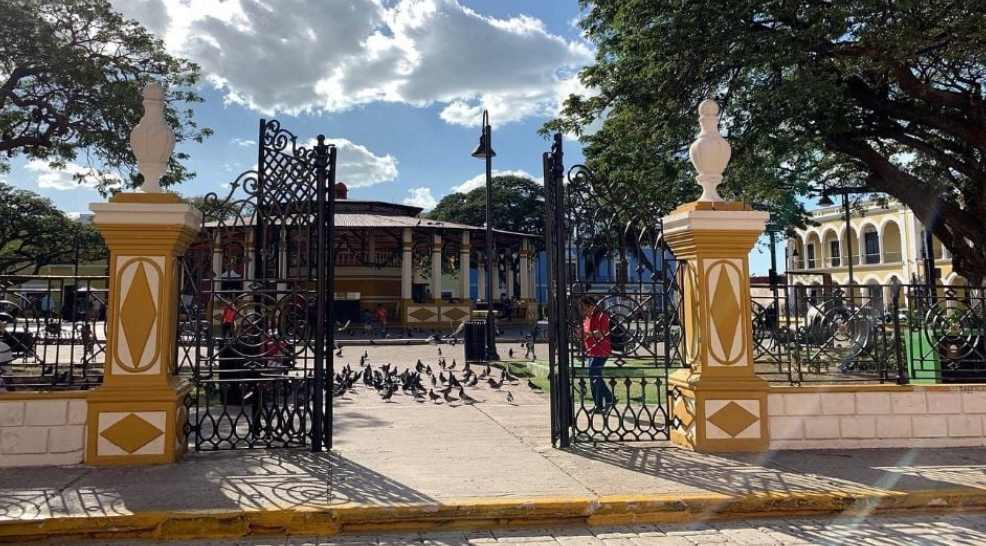

Public buildings inevitably carry a symbolic weight and a political meaning. Such is the case with the constructions and transformations of the Plaza de la Independencia in the city of Campeche over two centuries—a topic I addressed in my columns from January to May. The socio-cultural importance—appropriation, belonging, identity—understood in its close link with political connotation, also constitutes part of the discursive elaboration, although underlying the narrative of governmental power.
I consider that the history of the Campeche square can be read from the perspective of the imprint, tensions, and contradictions between two fundamental aims pursued by the different representatives of the executive power who acted upon it: one was to project within it signs that were, presumably, distinctive of progress; the other, to make it the representative symbol of a supposedly memorable past. That is, by studying the evolution of the square, it is possible to observe the process of transformation that led it to constitute itself, alternately, as a sign of modernity in the 19th century and a good part of the 20th century, and as a historical symbol by the middle and then the end of the 20th century.
The characteristics that the concepts modern and historical held in architectural-urbanistic terms—but, above all, within the dominant ideological-political discourse of each era—as well as the governmental motivations for seeking to impose one or the other, are fundamental to understanding the various interventions on the square and the profound impacts on its image. This analysis allows me to propose the existence of five stages of construction and transformation that mark the life of the square and the city of which it is the center. Five architectural changes that are framed within one of the two noted political strategies: a sign of modernity or a historical symbol. Thus, two of them correspond to the first aim (1857-1913 and 1914-1940), two to the second (1941-1962 and 1985 onward), and a third attempted to encompass both at the same time (1962-1984).
Although the central square was an object of attention during the first years of independent life when its name was changed to Plaza de la Independencia due to the push of movements in the political arena, the following decades passed, apparently, without major transformations affecting it. Toward the end of the 19th century, during the liberal phase, the square was the object of some government projects for its remodeling, this being part of the program of material improvements through which the city was sought to be embellished as a way to show the degree of civility achieved, which can be summarized in the liberal desire to build (1857-1913). Paradoxically, years later, the renewing airs that would arrive with the beginning of the new century and the Maderista Revolution would have no direct effect on the layout of the city; on the other hand, its appearance suffered a significant impact as a consequence of the works deployed by the brief administration of Manuel Rivera, a military officer who represented the reactionary government of Victoriano Huerta, as part of his work meant that the square, in addition to other urban spaces, underwent important changes in its physiognomy, thus imposing the seal of the counter-revolution (1914-1940).

Indeed, the modifications carried out by Rivera marked the beginning of a process that spanned the entire 20th century during which the square became the object of various impacts—modifications or transformations in the architectural design, variations in its surroundings, and ornamentation, among others—through which rulers, during different administrations, intended to express the political ideology of their respective governments. The government of Héctor Pérez Martínez set out to dismantle the signs of a heritage that he considered undermined the principles of the triumphant revolution, and in his modernizing zeal with a historical consciousness, he ended up returning an evocative air of Porfirism to the square—the very regime against which the revolution, of which he considered himself an heir, had risen (1941-1962).
The government project of José Ortiz Ávila aimed for a radical transformation of the urban physiognomy, including the square, based on the principle of functionality as a priority, and within that framework, he managed to quite successfully resolve the often-conflicting binomial of past-future (1963-1984). In the sixties, he intended to shift the center of the city to an extramural site close to the Plaza de la Independencia, building for this purpose a new government palace and a new civic square called the Plaza de la República; it is worth noting that he did not achieve his objective, although its existence contributed to reducing the square’s centrality in some aspects. What he did achieve successfully was the fusion of the different previous historical stages and the desire for progress and modernization in the new physiognomy of the square.
The case that represented the greatest discursive failure—even if successful in popular terms for some time—was that of Eugenio Echeverría and his intention to recover the echoes of a distant “colonial” stamped past, supposedly symbolized in the kiosk (1985 onward). The ignorance of history mixed with the governmental need to honor glorious times only sowed confusion among locals and outsiders, residents and visitors, who were told the tale of a colonial park.
The emergence and consolidation of a new space in the 20th century, known as the malecón (boardwalk), gradually over the years subtracted from the square its character as the articulating axis of the life of Campeche’s citizens, especially in the realm of sociability and recreation. In this context, I argue that the square was losing its character as a “center”—a reference point from which space was ordered and the city was experienced—and that this change ran parallel to the transformation of the square as it transitioned from constituting the sign of modernity and progress to consolidating itself as the symbol of recovered history. That is, the existence of other spaces like the Plaza de la República and, especially, the malecón, took away the square’s leading role—the former assuming the functions of the axis of government, and the latter becoming the benchmark of modernity and sociability.
Source: lasillarota